
Discover with us the Temple of all the Gods in Rome!
This itinerary takes us to the discovery of the Pantheon, one of the oldest temples in the world still in use today, albeit with the function of a church. Located in the heart of ancient Rome, the Pantheon is situated between Via del Corso and the suggestive Piazza Navona.
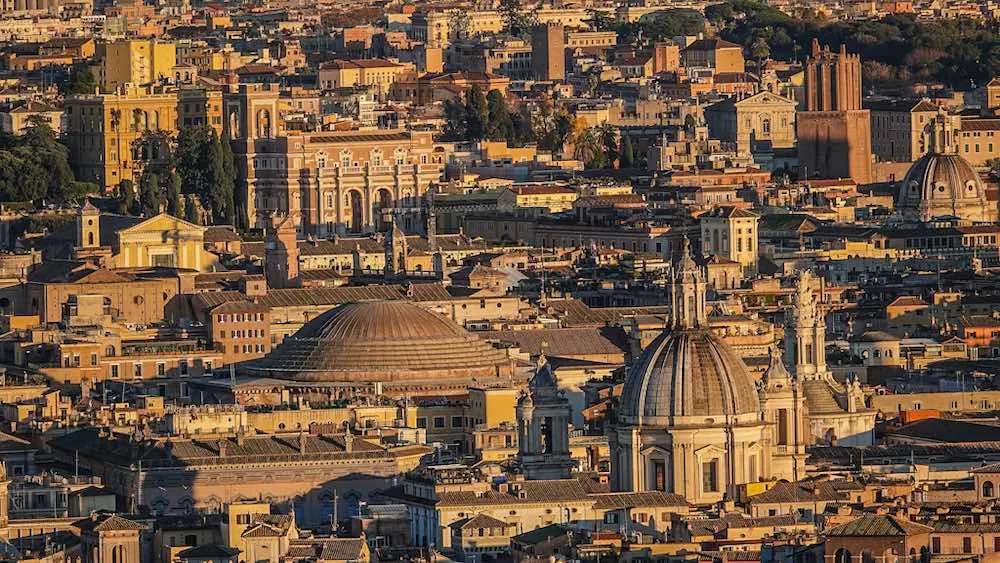
The Pantheon dome in the heart of Rome
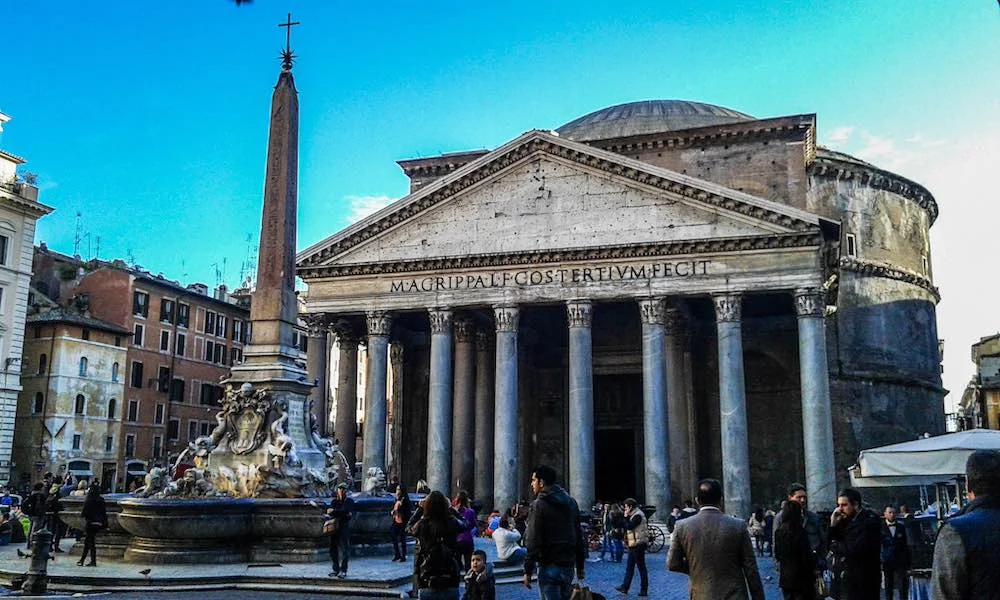
Piazza della Rotonda in Rome
It has survived practically intact for almost 2,000 years of history, a testament to the extraordinary perfection with which it was built.
In the history of architecture, the Pantheon represents a revolutionary monument.
The temple was dedicated to all the Gods: hence the name Pantheon. This dedication is also reflected in its circular shape.
The statues of the deities were placed inside alternating niches, some semicircular and others rectangular. The internal decorations, marbles, and columns have remained virtually unchanged.
What we will admire during our visit is, for the most part, exactly what a Roman citizen could see nineteen centuries ago.
The monument was rebuilt at the behest of Emperor Hadrian, in place of an older temple, built by Marco Vipsanio Agrippa, son-in-law of Emperor Augustus, as the ancient inscription still visible on the pediment recalls.
The works lasted seven years, from 118 to 125 AD. Today the tympanum (the triangular space above the columns of the entrance) is empty, but in Roman times it housed an imposing bronze altarpiece depicting the battle between the Giants and the Amazons.
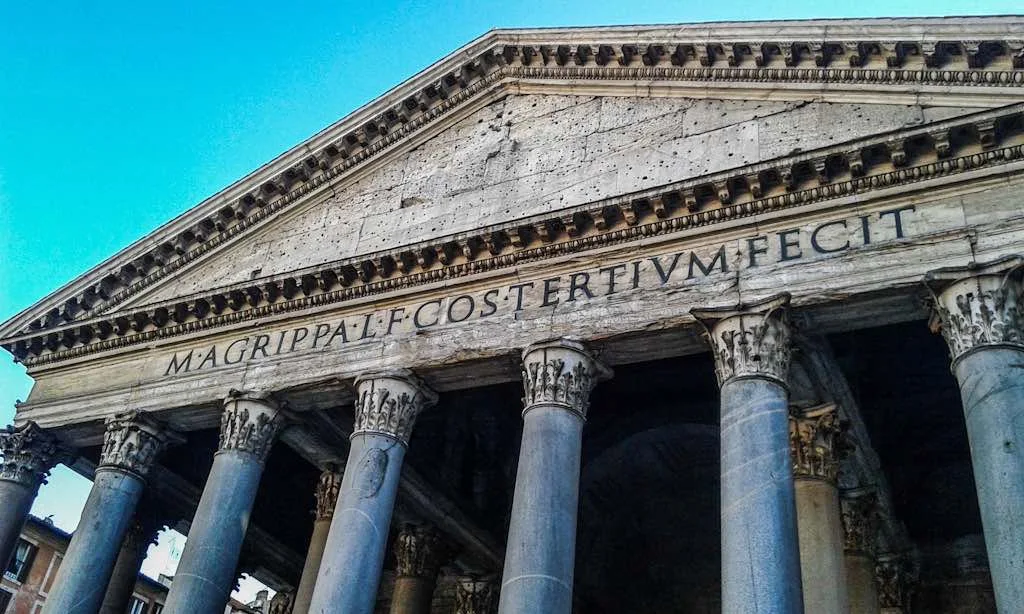
Pantheon tympanum and commemorative inscription of Agrippa
Even the ceiling of the pronaos (the entrance portico of the Pantheon) had been made using bronze, but the metal was removed in 1632 at the behest of Pope Urban VIII. The pontiff belonged to the Barberini family, and in Italy, a popular saying has become famous that says: «What the barbarians did not do, the Barberini did».
However, the bronze was not lost: it was melted and reused by Gian Lorenzo Bernini to create the famous Baldacchino with twisted columns, about 20 meters high, located in the center of St. Peter's Basilica.

Columns of the Pronaos of the Pantheon
Enter the Pantheon means finding yourself surrounded by 16 imposing monolithic columns, made of gray and pink granite from Aswan, a town in Egypt. The real entrance takes place through a 7-meter high bronze door.
After passing this door, we find ourselves inside a true masterpiece of ancient architecture: a huge and surprisingly empty space, in which we have the feeling of being really small. This was precisely the feeling that, even in ancient times, men had to experience in the presence of the Gods.
The entrance of the Pantheon
The floor is the original one and is made of precious marbles from all over the Empire: it is the same floor that Emperor Hadrian walked on and, after him, many other Roman emperors.
The dome is a true masterpiece of engineering: it is still the largest masonry dome in the world.
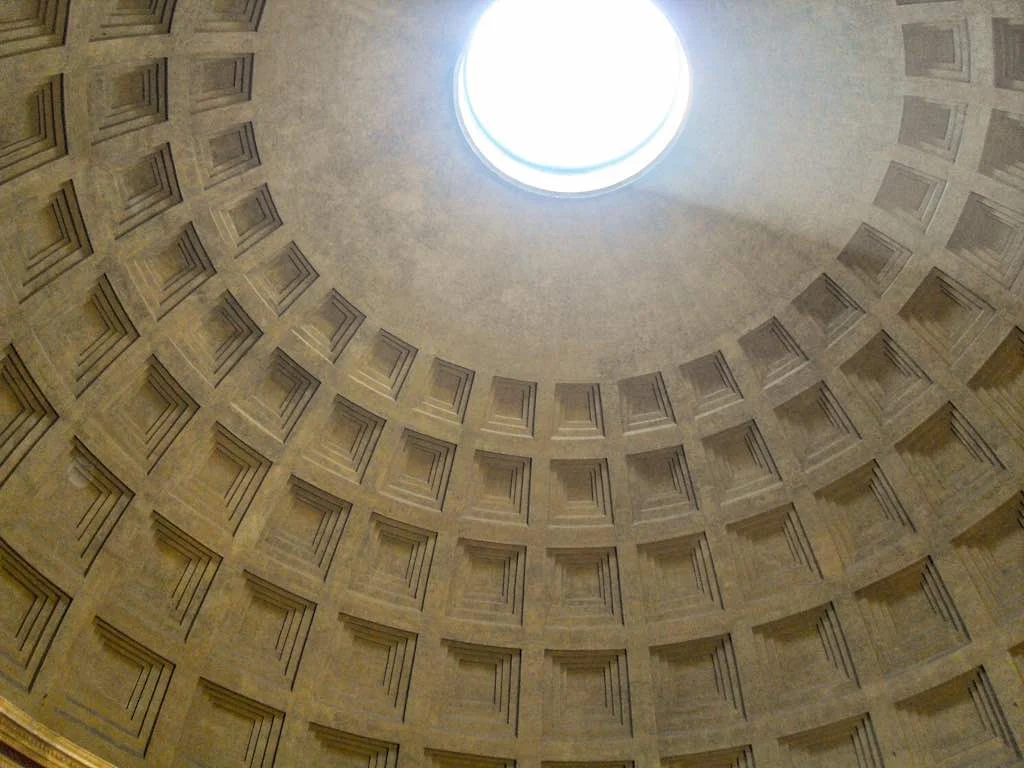
Oculus of the Pantheon
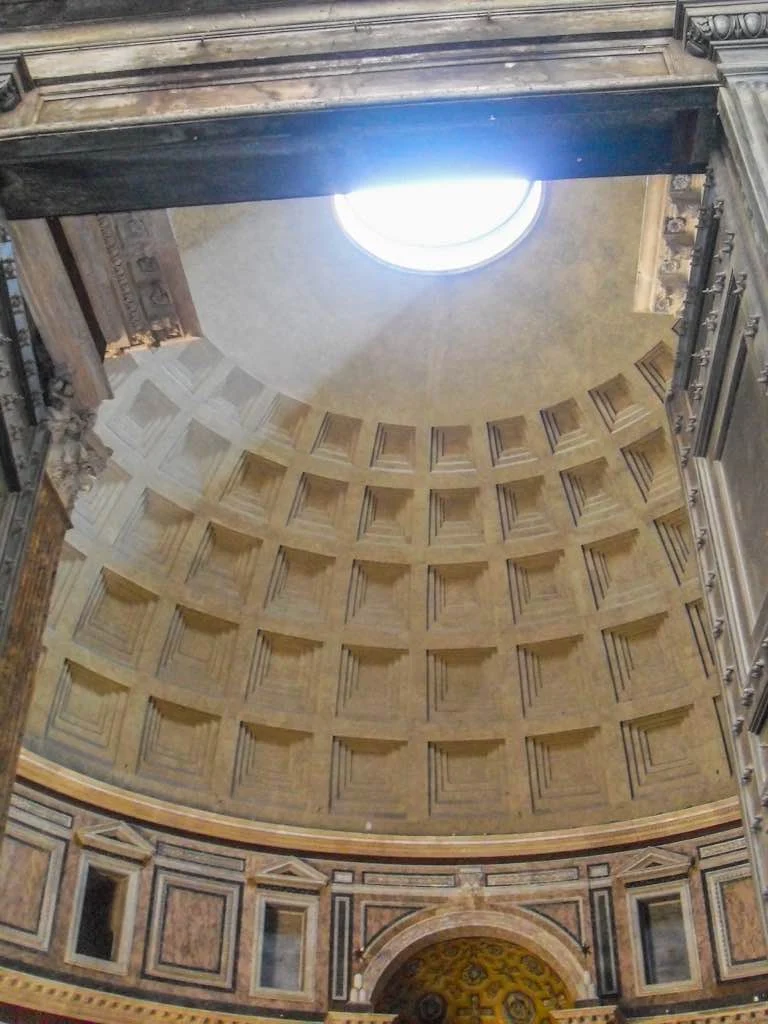
At the center of the dome opens an oculus, a circular opening with a diameter of 9 meters, which allows sunlight to illuminate the interior and appreciate the immensity of this place.
This means, however, that when it rains, water also enters the Pantheon.
For this reason, the marble floor was made with a slight slope, in order to convey rainwater towards 22 drainage holes, hidden among the inlays of the polychrome marbles.
A curiosity: the diameter of the dome, over 43 meters, corresponds exactly to the overall height of the Pantheon. The structure of the Pantheon makes it one of the greatest architectural masterpieces of all time.
The dome is a single structure made through the superimposition of successive layers of concrete on a wooden centring.
The Romans, however, did not use ordinary concrete: a dome made entirely with heavy materials would have been so massive as to risk collapsing. For this reason, in the lower part of the mixture, fragments of travertine were mixed with the cement.
Rising upwards, progressively lighter materials were used, such as terracotta fragments and pumice stone. In this way, as you proceed towards the top, the dome becomes lighter and thinner.
Even the decoration of the dome, composed of five rows of 'lacunari', or concentric coffers, had the purpose of lightening the structure.
The construction technique involved a progressive superimposition of layers, according to a principle that recalls that used to build an igloo. This technique fascinated Brunelleschi himself, who came to study the Pantheon before undertaking the construction of the famous dome of the Cathedral of Florence.
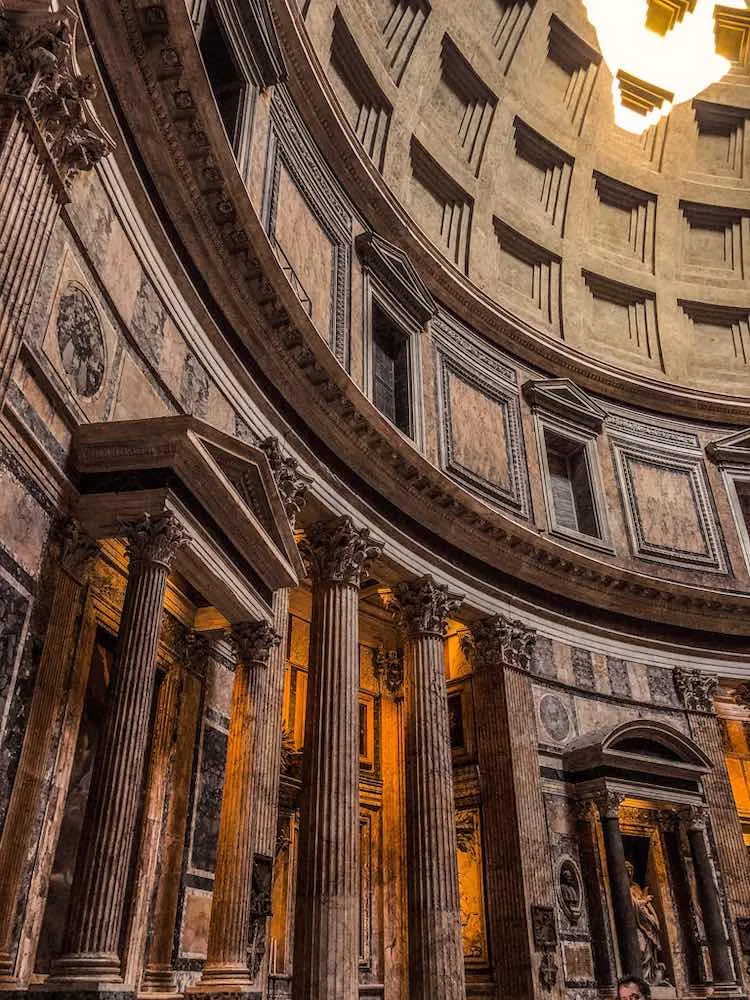
Coffered ceiling of the dome of the Pantheon
Its weight is impressive: over 5,000 tons, supported by a robust cylindrical structure in masonry, about 6 meters thick.
On the outside, it is possible to observe the arches inserted in the masonry, designed to distribute and unload the enormous weight of the coverage.
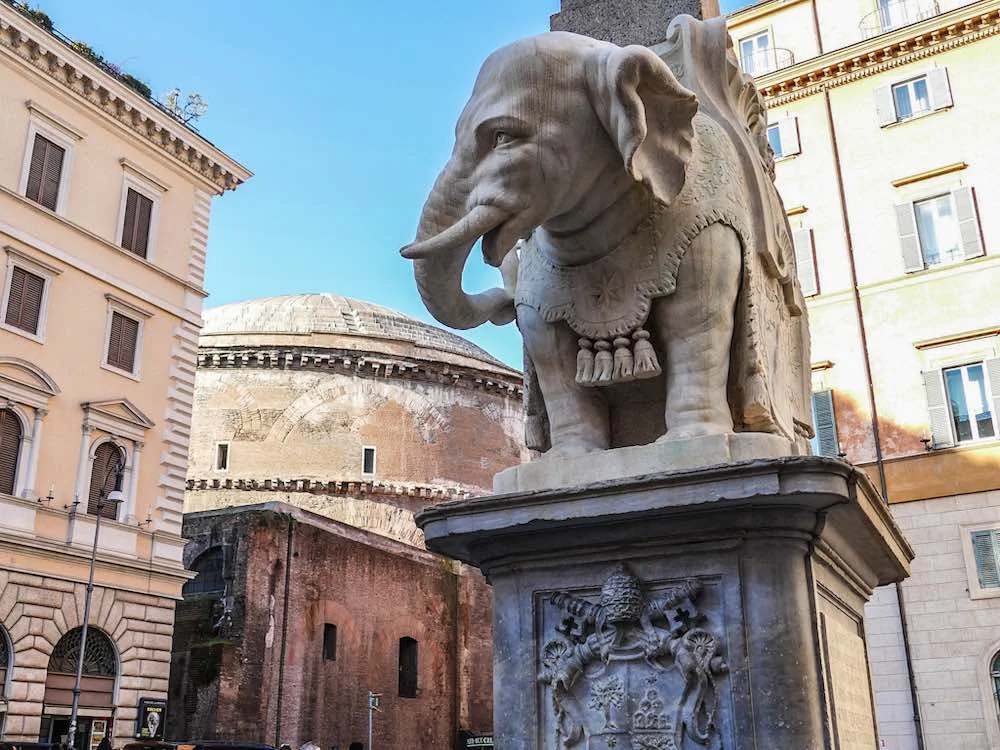
View of the Pantheon from Piazza Minerva in Rome
The Pantheon was not destroyed, like most pagan temples, because in 609 AD it was transformed into a church by the will of Pope Boniface IV.
Today the Pantheon is the Basilica of Santa Maria ad Martyres. In 1870 it became the shrine of the Kings of Italy, housing the tombs of Victor Emmanuel II, Umberto I and Margherita of Savoy.
The great Renaissance artist Raphael Sanzio is also buried in the Pantheon.
What are the opening hours of the Pantheon in Rome?
Generally, the monument is open every day from 9:00 to 19:00, with the last entrance at 18:30.
How can we help you?
👉🏽 Our guided tours offer you the opportunity to experience a stress-free tourist experience, saving time and optimizing your travel itinerary.
👉🏽 Do not hesitate to contact us at info@bestguidedtours.com. We will be happy to help you if you want to participate in our customized guided tours in Rome or if you are looking for inspiration to organize your next travel experiences in Italy.
We will continue to tell you about these places in our next itineraries to discover Rome.


